
A closer’s breakdown of Attio vs HubSpot for modern B2B teams: data model, automation, AI, integrations, real pricing, total cost, and when to pick which. We build on Attio, so we’ll be upfront about that and fair about where HubSpot wins.
At a glance
| Attio | HubSpot | |
|---|---|---|
| Data model | Flexible objects, model your own business | Fixed Contacts / Companies / Deals; custom objects on higher tiers |
| Marketing automation | Email + Sequences, no native landing pages or nurture | Full suite: landing pages, nurture, ads, attribution |
| AI | AI-native, agents read and write records | Assistive: content, summaries, forecasting hints |
| Integrations | Modern REST API, clean object semantics | Larger app marketplace |
| Entry price (sales) | Free (3 seats); Plus $29/seat; Pro $69/seat | Free (2 users); Starter $7/seat; Pro $90/seat |
| Onboarding fees | None | $1,500 (Pro), $3,500 (Enterprise) |
| Best for | Technical B2B GTM, product-led or outbound, 10 to 50 people | Marketing-led teams wanting one all-in-one suite |
The data model
HubSpot ships opinionated objects, Contact, Company, Deal, and Ticket, with custom objects gated to higher tiers. Attio treats objects as first-class, so you model your business the way it actually runs: Accounts, Deals, Contracts, Carriers, whatever you sell, with typed attributes and clean relationships. For product-led or usage-driven motions, Attio’s model removes weeks of workaround work.
Automation and workflows
HubSpot Workflows are mature and visual, tightly coupled to its marketing engine. Attio’s automation is newer, and it pairs cleanly with external orchestrators like n8n, Zapier, and Make through a first-class API and webhooks. That’s a better fit for teams already running automation outside the CRM.
AI and agents
HubSpot’s AI is mostly assistive: content generation, summaries, forecasting hints. Attio is built as an AI-native workspace, with enrichment, research, and triage that read and write records directly. If you plan to put agents inside your GTM, Attio removes the sync tax.
Integrations and extensibility
HubSpot has the larger marketplace, no argument. Attio’s edge is a modern REST API, SDKs, and clean object semantics, which is why we default to Attio for teams stitching Apollo, Aircall, enrichment, billing, and product telemetry into one operating system.
Pricing
Here’s where “HubSpot looks cheaper” needs a closer look. All figures below are per seat and current as of July 2026, so check both pricing pages before you budget.
Free up to 3 seats. Plus $29/seat/month. Pro $69/seat/month. Enterprise custom. No onboarding fees.
Free up to 2 users. Starter $7/seat/month. Pro $90/seat/month. Enterprise $150/seat/month. Pro adds a $1,500 onboarding fee, Enterprise $3,500.
A quick total-cost example
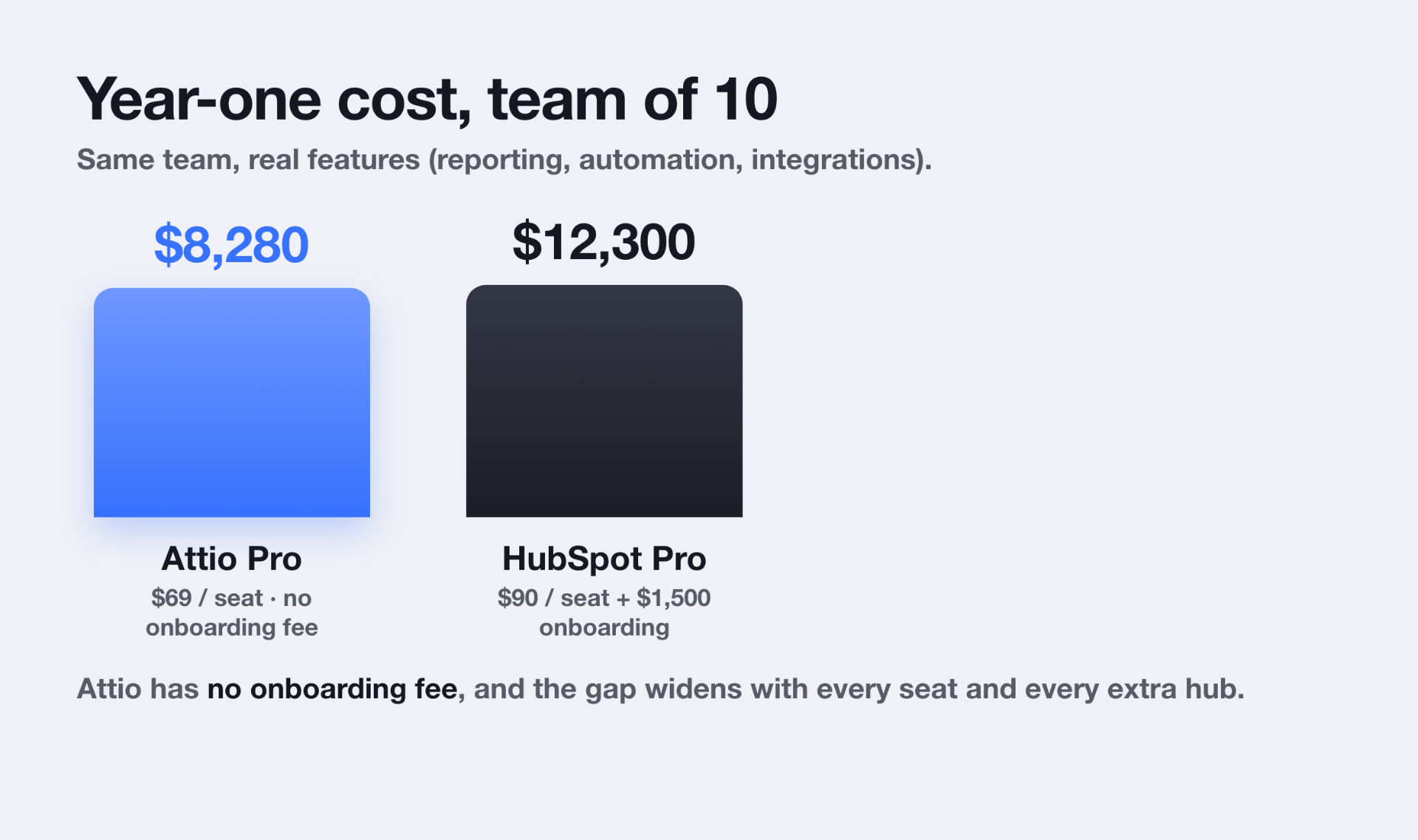
Say a technical GTM team of 10 needs real CRM features (reporting, workflow automation, integrations). On Attio that’s Pro at $69/seat, about $8,280/year. On HubSpot that’s Sales Hub Professional at $90/seat plus the $1,500 onboarding, about $12,300 in year one. Need custom objects too? HubSpot gates those to Enterprise at $150/seat, which pushes year one past $21,000, while Attio includes a flexible data model on Pro. The gap widens with every seat and every extra hub (Marketing, Operations, Service) you bolt on, and Attio’s per-seat pricing stays predictable.
One point in HubSpot’s favor: HubSpot for Startups gives eligible pre-seed to Series A venture-funded startups up to 90% off in year one, then 50% in year two and 25% in year three. If you qualify and you want the full suite, that changes the first-year math.
Migrating from HubSpot to Attio
If you’re leaving HubSpot, Attio’s built-in Import2 pulls your companies, people, deals, custom objects, notes, and tasks across for free on paid plans. The one gotcha: disable email sync before you import, or a synced mailbox will auto-create duplicate records. Budget a couple of weeks for a clean migration, more if your HubSpot data needs a scrub first.
When to pick which
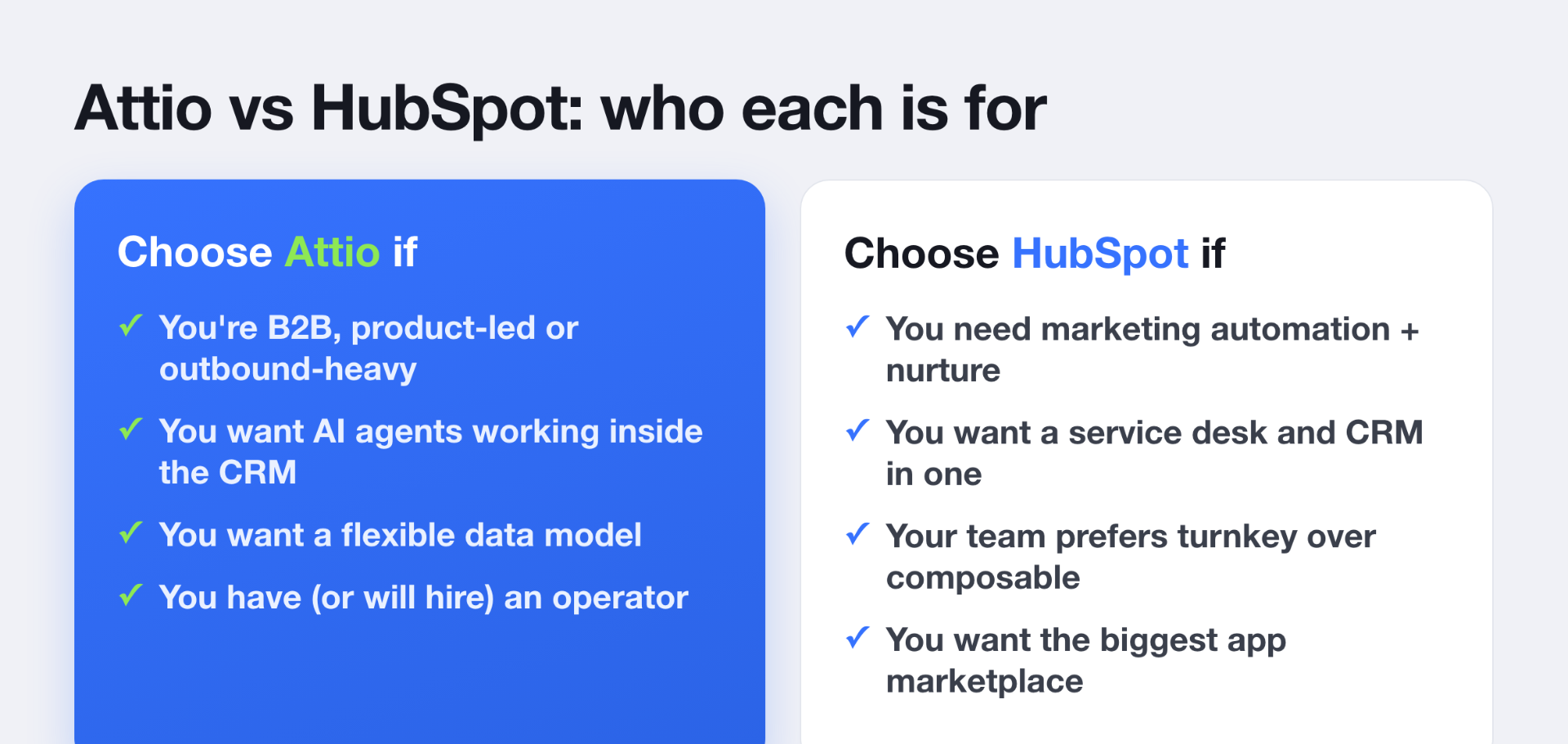
You’re B2B, product-led or outbound-heavy, want AI agents in the CRM, and have (or will hire) an operator who can shape the data model.
You need marketing automation, a service desk, and a CRM in one place, and your team prefers turnkey over composable.
A quick scale check
For context on who you’re choosing between (figures as of early 2026): HubSpot is the incumbent, with 288,706 paying customers and $3.13B in 2025 revenue (HubSpot FY2025 results). Attio is the fast-moving challenger, a $52M Series B from Google Ventures, $116M raised, 5,000 paying customers, and users like Modal, Granola, and Replicate (Attio). You’re weighing a mature suite against a modern, AI-native system, not a safe bet against a gamble.
The prospr take
We build on Attio because it lets us design a CRM that mirrors how revenue actually moves: signals in, actions out, agents doing the work between. HubSpot is a fine CRM. It’s rarely the right operating system for a technical, AI-native GTM team.
FAQ
Is Attio better than HubSpot?
Neither is simply “better.” Attio fits technical, AI-native B2B teams. HubSpot fits marketing-led teams that want one all-in-one suite.
Is Attio a good CRM for startups?
Yes, especially B2B startups that want a flexible data model and predictable per-seat pricing.
How much does Attio cost compared to HubSpot?
Attio Plus is $29 a seat, Pro is $69. HubSpot Sales Starter is $7 a seat, Professional is $90 plus a $1,500 onboarding fee. HubSpot is cheaper at entry, Attio is usually cheaper once you need real features at scale.
Does Attio have marketing automation like HubSpot?
No. Attio has email and Sequences, but no native landing pages, nurture campaigns, or ad attribution. Marketing-led teams pair it with dedicated tools.
Can Attio replace HubSpot?
For sales and RevOps, yes. For a full marketing and service suite, not on its own.
Is HubSpot’s free CRM good enough for a startup?
For 2 users and basic contact management, it can be. It gets expensive the moment you need Professional features and the onboarding fee that comes with them.