
A lot of salespeople hate objections. You should be happy when you get them.
An objection isn’t a rejection. It’s a question dressed up as resistance, and a question means the person is still in the room, still thinking, still asking you to do your job. The deal that dies quietly, with a polite “we’ll be in touch,” is the one to worry about. The one where they push back on price, timing, or trust? That’s the conversation that actually matters finally starting.
Bad salespeople treat an objection like a stop sign. They get defensive, they argue, they feature-dump. Good salespeople treat it like a green light. Every objection tells you exactly what’s standing between the buyer and the decision. Handle it well and you don’t just save the deal, you build the trust that closes it.
The framework: how to handle any objection
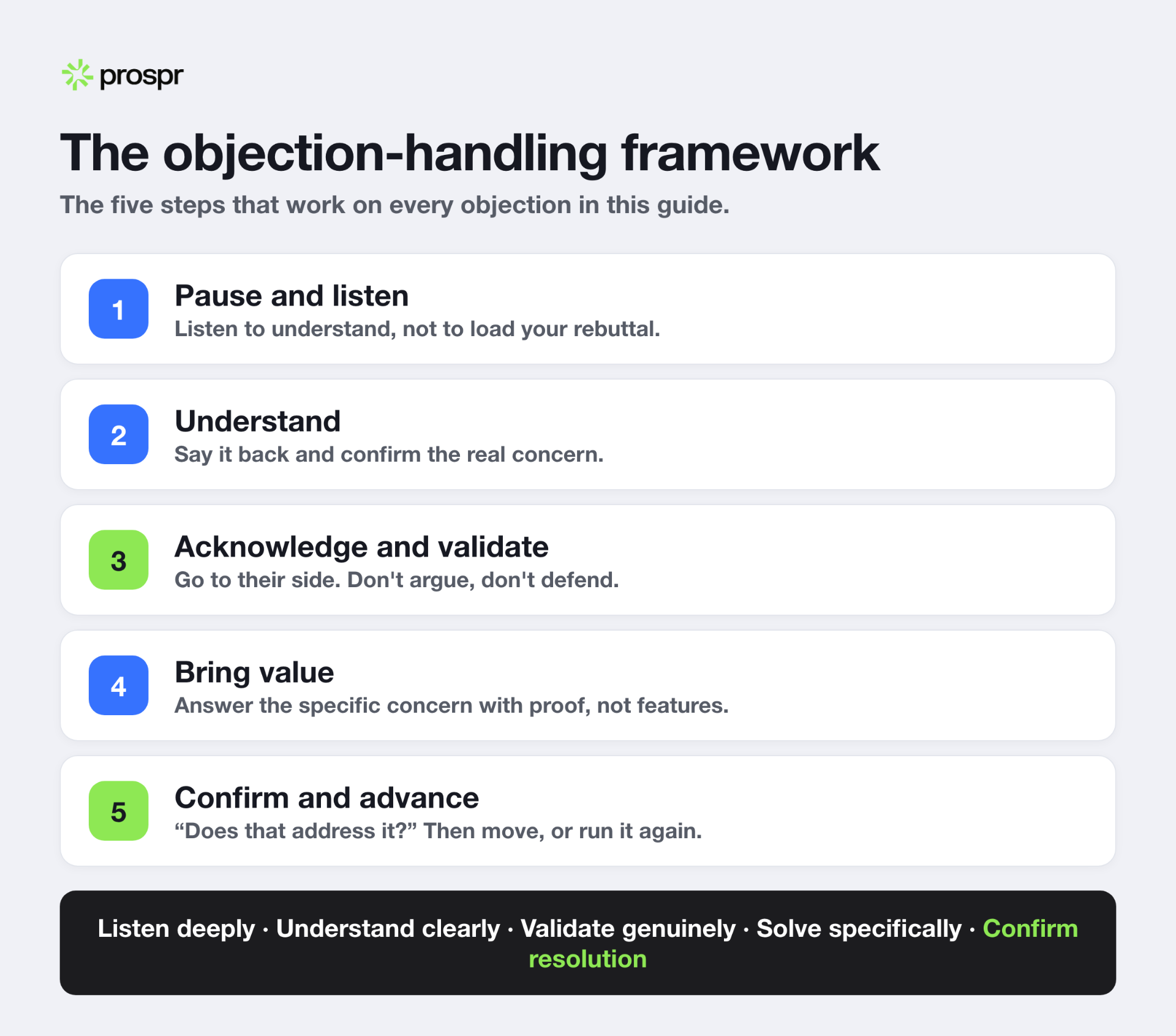
In short:
- Pause and listen. Understand the concern, don’t load your rebuttal.
- Understand. Say it back and confirm the real issue.
- Acknowledge and validate. Go to their side.
- Bring value. Answer the specific concern with proof, not features.
- Confirm and advance. Check it’s resolved, then move.
There are plenty of objection frameworks out there. LAER, LAARC, ARC, Feel-Felt-Found. They’re all fine, and they’re all teaching the same core idea from different angles: don’t rush to respond, understand first. Here’s the version I run, in five steps. It works on all 50 objections below and every one I didn’t list.
1. Pause and listen
Actually listen, not just stop talking. Listen to understand what they’re really saying, not to load your rebuttal. This does two things: it helps you find the real issue, and it shows them you’re not just waiting for your turn to pitch. Most reps skip this. Don’t.
2. Understand
A lot of frameworks jump straight to “validate.” There’s a step before that: make sure you actually understand the objection. Say it back in your own words and ask them to confirm.
“So if I’ve got this right, your concern is X, not Y. Is that fair?”
This gets you clarity, and it shows them you’re paying attention. Half the time, saying it back surfaces that the real objection is something else entirely.
3. Acknowledge and validate
Now go to their side. Be on their team. Don’t argue, don’t defend, don’t get reactive. If they say it’s too expensive, don’t jump into features. Show them you get it: “Yeah, with what’s going on in the economy, budget scrutiny is real.” Then, if you need to, ask one more question to get the full context.
“That makes sense. When you say the ROI feels uncertain, which part specifically?”
4. Bring value, not a feature dump
Now you answer, and you answer their specific concern, not a generic pitch. This is where most reps go wrong: they sell features instead of solving the actual issue. Instead:
- Remind them of the goal they told you they want.
- Address the specific concern with proof: data, a case study, an example, social proof.
- Show the risk of doing nothing.
- Show the upside of making the right move.
5. Confirm and advance
Don’t assume you’ve handled it. Confirm. Quickly summarize their concern, your answer, and the next step, then ask:
“Does that address it?”
If yes, great, move to the next step. If no, also great. Stay with it, find out what’s still unresolved, and run the same five steps again. An objection isn’t handled until they tell you it is.
Listen deeply. Understand clearly. Validate genuinely. Solve specifically. Confirm resolution.
Why people object: the psychology
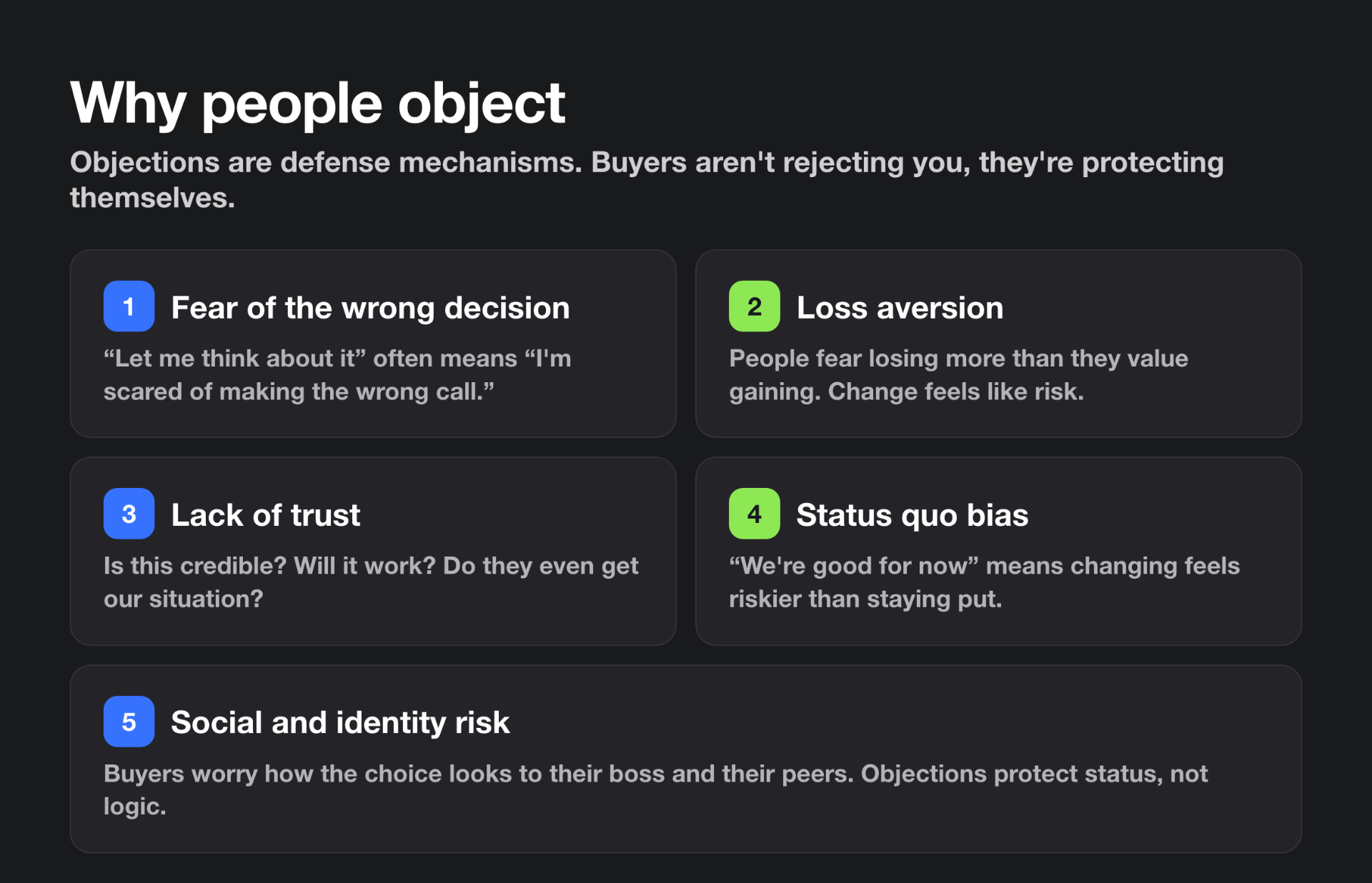
If you want objections to get easier, stop reacting to the words and start reading the worry underneath them. Objections are defense mechanisms. The brain uses them to manage risk, uncertainty, and social consequences. Buyers aren’t rejecting you or your product. They’re protecting themselves.
Almost every objection is one of these five worries wearing a costume:
- Fear of making the wrong decision. “Let me think about it” often means “I’m scared of making the wrong call.”
- Loss aversion. People fear losses more than they value gains. Change feels like risk.
- Lack of trust. Is this credible? Will it work? Do they even get our situation?
- Status quo bias. “We’re good for now” means changing feels riskier than staying put.
- Social and identity risk. Buyers worry how the choice looks to their boss and peers. Objections protect status, not logic.
When you speak to the worry instead of just the words, the conversation gets a lot easier.
How to use these 50 objection scripts
Every objection below runs through the same framework. Listen, confirm the real concern, validate it, then reach for the response that fits. The scripts here are the “bring value” move, what you actually say once you’ve done the first three steps. A few rules:
- Never argue with the objection. Validate first, then address.
- Use their words back. Mirror their language when you answer.
- Handle it now. Don’t skip it or promise to “circle back.”
- One objection at a time. Pick the one that fits and say it.
- Say it out loud. Adapt it to your voice, repeat it until it’s natural.
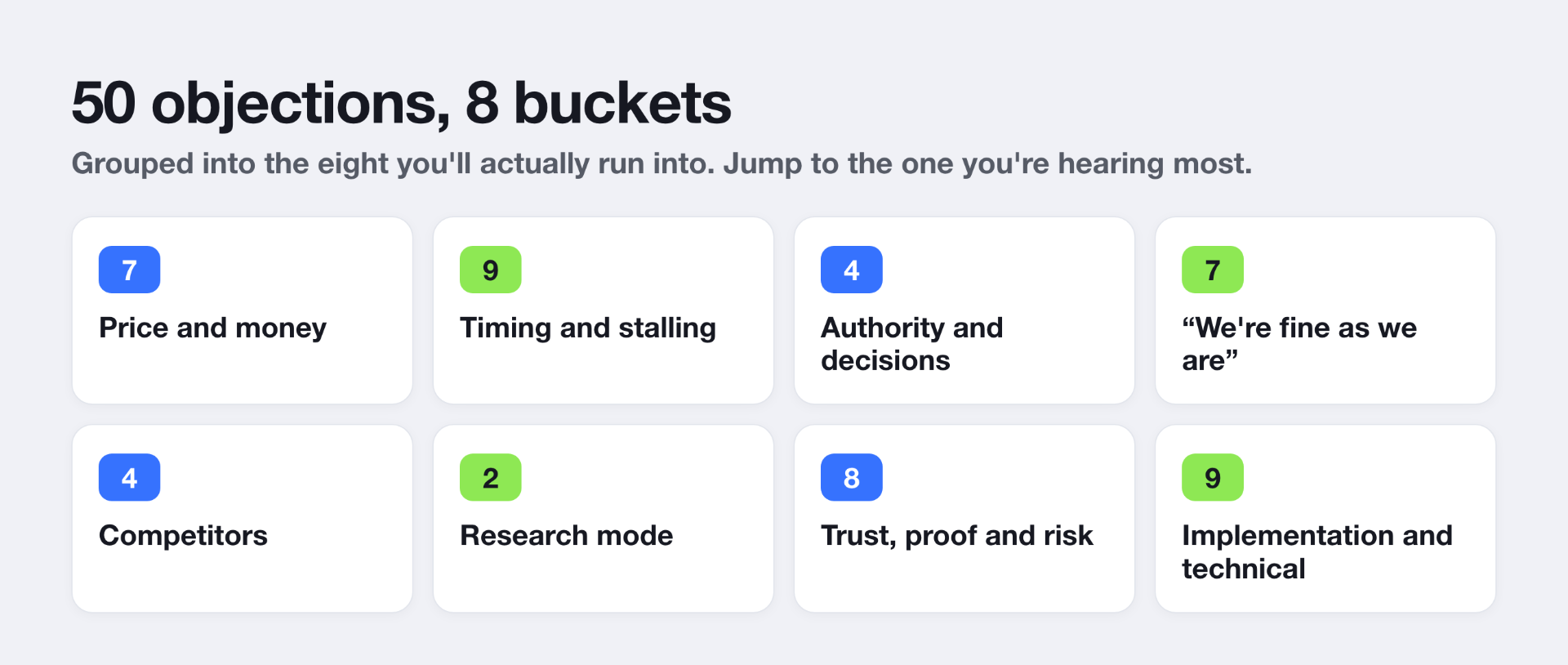
Price and money objections
These are almost always a value gap or a test, not a real “no.” Answer with value and perspective. Don’t cave on price first.
“It’s too expensive.”
WHAT THEY’RE REALLY SAYING · They don’t see enough value to justify the number yet, or they’re poking to see if you’ll drop the price.
- VALUE REFRAME
“I get that price matters. If we can show this fixes [their problem] and saves you [amount] in the next [timeframe], does the investment make sense?”
Moves them off cost and onto ROI.
- COST OF INACTION
“Fair. What’s it costing you right now to not have this solved? That’s the real number we’re comparing against.”
Puts the price of doing nothing on the table.
- BREAK IT DOWN
“Let’s put it in perspective. That’s about [daily/monthly cost], less than [small relatable expense], to solve [their problem].”
Makes the number feel smaller.
If price wasn’t the concern, is this the solution you’d want?
“What’s your best price?”
WHAT THEY’RE REALLY SAYING · They’re testing whether you’ll discount and whether there’s room to negotiate before they even commit.
- ANCHOR TO VALUE
“Depends what you need. Standard is [price], but before we talk pricing, let’s make sure we’re solving the right problem. What matters most: speed, features, or support?”
Pulls the conversation back to value.
- CONFIDENCE IN PRICING
“Our price is already our best price. What you’re paying for is [specific value]. Find the same value for less, bring it to me and we’ll talk.”
Signals you stand behind the number.
- VOLUME ANGLE
“We do improve pricing for longer commitments or larger rollouts. Commit to [term/volume] and we can move. What works for you?”
Ties movement to something that benefits you too.
Is price the main factor, or are there other considerations?
“Can you discount?”
WHAT THEY’RE REALLY SAYING · They’re testing how flexible you are and whether pushing gets them a better deal.
- CONDITIONAL
“We can move on price if the conditions are right. Commit to [longer term/annual/volume] and I can do [specific discount]. Work for you?”
Ties the discount to something that benefits you.
- ADD VALUE INSTEAD
“Instead of cutting price, let me show you how to get more out of this. Most clients never touch [feature] that saves [amount]. Let’s max out what you’re already paying for.”
Grows value instead of shrinking the deal.
- STRAIGHT TALK
“I won’t play games on price. Here’s what I can do: [offer]. Here’s what I can’t: [limit]. Does that work?”
Trades a discount for trust.
What would make this investment feel right for you?
“Found it cheaper elsewhere.”
WHAT THEY’RE REALLY SAYING · They’re comparing on price alone and don’t see the quality or service difference yet.
- REFRAME COMPARISON
“I’m sure you did. The question isn’t lowest price, it’s best value. What are they including? Because we include [value-adds] most charge extra for.”
Shifts the fight from price to value.
- TRADE-OFF
“Good research. Help me understand what you’re giving up with that option: support, quality, implementation? There’s always a trade-off.”
Surfaces the hidden cost of the cheap option.
- CONFIDENT COMPARE
“Send me their proposal and I’ll show you side by side what you’re actually getting. I’m confident the value’s clear.”
Signals you have nothing to hide.
If the price was equal, would you choose us on what we offer?
“I can do it myself cheaper.”
WHAT THEY’RE REALLY SAYING · They’re weighing DIY, or they don’t value your expertise enough yet.
- TRUE COST
“Probably. Let’s do the real math though. [Hours] at [rate], plus the learning curve and opportunity cost, is [total], and you still won’t have [expertise]. Does that math hold?”
Exposes the full cost DIY hides.
- TIME VALUE
“You could. Is it the best use of your time though? What could you be doing instead that’s worth more to the business?”
Reframes their time as the expensive part.
- RISK
“You could, but then you own the risk. If it goes wrong, you fix it. With us, we carry that. For [price], that peace of mind usually pays for itself.”
Prices in the risk they’d be taking on.
If you did decide to outsource this, would we be your first call?
“Can’t afford it right now.”
WHAT THEY’RE REALLY SAYING · Cash flow is tight, or they see the value but they’re pushing the spend down the list.
- EXPLORE TIMING
“I hear you. When would the timing be better? And should we lock in this pricing now so you’re ready when budget opens up?”
Keeps the deal alive and protects today’s price.
- PAYMENT FLEXIBILITY
“Most teams in your spot use a payment plan. We could spread this into [monthly/quarterly], which might fit cash flow better. Would that help?”
Removes the lump-sum wall.
- ROI
“Budget’s tight, I get it. But if this generates [ROI] in the first [timeframe], it basically pays for itself. That’s how most teams justify it internally.”
Turns the spend into a self-funding case.
What would need to happen for this to become a budget priority?
“Budget’s already allocated.”
WHAT THEY’RE REALLY SAYING · The money is committed elsewhere, or they haven’t made room for new spend.
- REALLOCATION
“Understood. But if this solves a bigger problem than what the budget’s on now, doesn’t it make sense to reallocate? What’s that budget going toward?”
Opens the door to shifting priorities.
- NEXT CYCLE
“When does your next budget cycle open? Let’s get you on the agenda, and I’ll send a proposal so we can lock pricing and you’re ready to move.”
Plants the deal in the next round.
- COST OFFSET
“What if we offset this by cutting spend somewhere else? If this eliminates [expense], you’re basically getting it for free. Want to look at that?”
Funds the deal from savings.
Is there a way to make room for this now if the value’s strong enough?
Timing and stalling objections
“Later” is where deals go to die. Figure out whether it’s a real timing issue or a hidden concern, and keep the deal moving either way.
“I need to think about it.”
WHAT THEY’RE REALLY SAYING · There’s a concern they haven’t voiced, they’re not the one who actually decides, or they’re dodging a straight no.
- SURFACE IT
“Of course, it’s an important call. So I can actually help, what specifically do you need to think through: the price, the fit, the timing, or something else?”
Pulls the real objection into the open.
- RESOLVE NOW
“‘Think about it’ usually comes down to one specific concern. Sort it now and you walk away with clarity instead of doubt. What’s the main thing you’re weighing?”
Turns a stall into a solvable question.
- SET THE NEXT STEP
“Let’s grab 15 minutes tomorrow after you’ve slept on it, so anything that comes up we handle right away. Does [time] work?”
Keeps momentum with a firm follow-up.
What’s your usual decision process for something like this?
“I want to think about it.”
WHAT THEY’RE REALLY SAYING · Same story. Either a hidden concern or a genuine need to process.
- ONE REAL QUESTION
“When people say that, it’s usually one thing they want to be sure about before they commit. What’s that one thing for you?”
Narrows a vague stall down to one point.
- STRUCTURED TIME
“Take 24 hours, then let’s jump on a quick call so I can clear up anything that came up. That way you’re not sitting with the uncertainty. Fair?”
Gives them space without losing the thread.
- DECISION FRAME
“Here’s what I’d weigh if I were you: [criteria]. Use that to pressure-test it, then let’s talk it through.”
Hands them a way to decide with confidence.
What’s the one thing that would make you feel confident about moving forward?
“I need more time to decide.”
WHAT THEY’RE REALLY SAYING · They’re genuinely considering it and need to process, or they’re avoiding commitment.
- SET A DEADLINE
“How much time do you need? Let’s put a date on it, say [date], to reconnect with a decision made. Work for you?”
A date beats an open-ended maybe.
- REMOVE PRESSURE
“Take the time. No pressure. While you’re thinking, here are three things that usually help people decide faster: [resources].”
Respects their pace and moves them along.
- INTERIM CHECK-IN
“I’ll check in [timeframe] to see if any questions came up, so you’re not sitting on it alone. Sound good?”
Keeps you in the loop without pushing.
What questions do you need answered before you can decide?
“It’s not the right time.”
WHAT THEY’RE REALLY SAYING · They’re busy, distracted, or they don’t feel any urgency yet.
- EXPLORE THE TIMELINE
“When would be the right time? And what would need to change for this to become a priority?”
Gets them to define what ‘right’ looks like.
- CREATE URGENCY
“The longer you wait, the more this costs you. Every [timeframe] without it is costing [impact]. Isn’t it better to fix it now?”
Puts a price on the delay.
- MINIMAL START
“What if we start small? Just [limited scope] to get the benefit now, and expand later when you’ve got the bandwidth?”
Lowers the bar to a yes.
What would make now the right time?
“The timing isn’t good.”
WHAT THEY’RE REALLY SAYING · Something outside the deal makes this a bad moment, or they’re just not ready.
- UNDERSTAND THE CONSTRAINT
“What’s making the timing tough: a project you’re mid-way through, budget, something else? Help me understand so we find the right window.”
Finds the real blocker.
- PLAN FOR LATER
“When would timing be better? Let’s put it on the calendar and start planning now, so when it comes you move fast.”
Books the future instead of losing it.
- PARALLEL PATH
“Start the conversation now, delay implementation until timing’s right. That way we’re aligned and ready to execute when you are.”
Keeps the deal alive without forcing the clock.
When the timing’s right, will we be your first choice?
“Too busy right now.”
WHAT THEY’RE REALLY SAYING · They’re overwhelmed, or they’re worried the rollout will be a mess.
- REDUCE THEIR BURDEN
“That’s exactly why this matters. We do the heavy lifting, you just [minimal action]. You’ll end up with more time, not less.”
Reframes the ask as relief, not work.
- DEDICATED SUPPORT
“Being busy is exactly when you need this. We put a dedicated person on it, so you don’t have to think about it, we handle it.”
Takes the load off their plate.
- PHASED ROLLOUT
“Let’s spread it out. We roll it in phases so you’re never buried. First phase is [minimal scope], then we build. More manageable?”
Shrinks it to something they can say yes to.
If we could make this easy, would you want to move forward?
“We need to wait until next quarter.”
WHAT THEY’RE REALLY SAYING · Budget cycles are the constraint, or they’re delaying for reasons they haven’t named.
- LOCK PRICING
“Let’s lock today’s pricing so when next quarter hits, you move without worrying about an increase. Fair?”
Removes the reason to wait.
- EARLY START
“What if we start planning now, so when budget opens next quarter you’re ready to go immediately? We get ahead of it.”
Uses the wait instead of losing it.
- INTERIM VALUE
“In the meantime, here’s what we can do for free to help you prep: [interim help]. You get value now, we scale next quarter.”
Builds trust before a dollar changes hands.
Can we book a planning call for next quarter so we hit the ground running?
“Call me back in [timeframe].”
WHAT THEY’RE REALLY SAYING · Not ready now but maybe later, or it’s a polite brush-off.
- QUALIFY IT
“Before I do, quick check: in [timeframe] will you have budget, and will you be the decision maker? Just want us on the same page.”
Tests whether the callback is real.
- PREP THE GAP
“Meanwhile I’ll send some resources so that when I call back, we pick up mid-conversation instead of starting over.”
Keeps the thread warm.
- SPECIFIC AGENDA
“I’ll call [date/time]. When I do, let’s cover [topics]. Work for you?”
Turns a vague callback into a real appointment.
Anything I can send you in the meantime to help you prepare?
“This isn’t a priority right now.”
WHAT THEY’RE REALLY SAYING · They see the value, but other things are ahead of it in line.
- CONNECT TO PRIORITIES
“What is the priority right now? Because sometimes solving this actually helps with that. How does it fit?”
Ties your solution to what they already care about.
- COST OF WAITING
“Every [timeframe] without this is [impact]. At some point it becomes a priority, the question is how much it costs you first.”
Makes the delay expensive.
- LOW-EFFORT START
“What if we start small, just [minimal scope] that doesn’t touch your current priorities? You get benefit now, expand later.”
Fits in around what they’re already doing.
When will this become a priority?
Authority and decision-process objections
When they’re not the final yes, don’t push harder. Make it easy for the real decision to happen. Arm your champion, or get yourself in the room.
“I need CFO approval.”
WHAT THEY’RE REALLY SAYING · They’re not the one who signs. There’s a formal approval process standing between you and the deal.
- DO THE WORK FOR THEM
“Absolutely. Let me build you a one-page business case with the ROI so this is easy to bring up. What does your CFO care about most, cost savings, revenue, or risk?”
You take the friction off their plate.
- DIRECT MEETING
“Happy to present to your CFO myself. It’s usually quick, just the business case and the numbers. Want me on a call with both of you?”
Gets your case to the person who signs.
- CFO-READY PACK
“Most CFOs want three things: ROI, risk mitigation, and a timeline. I’ve got a one-pager that covers all three. Can you get it in front of them this week?”
Speaks the CFO’s language and sets a clock.
What’s the fastest way to get this in front of your CFO?
“Let me talk to my team first.”
WHAT THEY’RE REALLY SAYING · They don’t decide alone. They need buy-in from the people they work with before they can move.
- TEAM-READY MATERIALS
“Of course. Let me put together a summary for your team so that’s easier. What are their main concerns likely to be? I’ll address those upfront.”
You pre-load the internal sell.
- JOIN THE ROOM
“Happy to jump on a call with your team, answer questions directly, get everyone aligned faster. Would that help?”
Fewer games of telephone, faster alignment.
- ONE-PAGER
“Here’s what usually helps: a one-pager covering the business case, the plan, and the ROI. Gives them what they need to weigh it. Sound good?”
Hands the team a clean way to say yes.
When will you get a chance to talk to your team?
“I need to run this by [decision maker].”
WHAT THEY’RE REALLY SAYING · They need a yes from someone above them before this goes anywhere.
- MAKE APPROVAL EASY
“Of course. Let me prep a summary for [decision maker] so that conversation’s easier. What are their main concerns? I’ll handle those upfront.”
You arm your champion for the ask.
- GO DIRECT
“Happy to talk to [decision maker] myself. Sometimes it’s easier person to person. Would that move things along?”
Skips the relay and puts you in the room.
- DECISION PACKAGE
“Here’s what works: I’ll send a package with the business case, ROI, and plan, so [decision maker] can approve it fast.”
Everything they need in one place.
When can you get this in front of [decision maker]?
“I’m not the decision maker.”
WHAT THEY’RE REALLY SAYING · They’re a gatekeeper or an influencer, not the final yes. Straight with you about where they sit.
- USE THEIR INFLUENCE
“Appreciate you being straight with me. You clearly have influence here. If you thought this made sense, would you recommend it to [decision maker]?”
Turns an honest admission into a champion.
- GET INTRODUCED
“Understood. Would you introduce me to [decision maker], so I can talk it through with whoever signs off?”
Gets you to the real authority.
- ASK FOR THE MAP
“Got it. Help me understand the process. What does [decision maker] care about most, and what’s the best way to get in front of them?”
You learn how the deal actually gets done.
Can you walk me through how decisions actually get made here?
“We’re fine as we are” objections
Status quo is the toughest competitor you’ll ever meet. It has no sales team, no pricing, no roadmap, and it wins deals every day. Surface the cost of staying put.
“We don’t need it.”
WHAT THEY’RE REALLY SAYING · They don’t see the problem yet, or the pain hasn’t hit hard enough to register.
- UNCOVER HIDDEN PAIN
“Maybe not today. Quick question though: are you currently [pain point]? Because most teams in your spot are, and it’s costing them without them clocking it.”
Gets them to admit a problem they’ve stopped noticing.
- SHOW THE IMPACT
“You might not need it today. But teams like yours are losing [amount] by not [action]. Does that land?”
Puts a number on the silent cost.
- LEAVE A MARKER
“Fair enough. If you ever do need it, here’s what to watch for: [indicators]. When you see those, reach out.”
Keeps the door open without pushing.
What would need to happen for this to become relevant to you?
“We already have a solution.”
WHAT THEY’RE REALLY SAYING · They’ve got something in place. It might be duct tape, but it’s theirs, and switching feels like work.
- EXPLORE LIMITS
“I’m sure you do. What’s working well with it? And what’s not working as well as you’d like?”
Their own answer surfaces the gap.
- COMPARE
“Most teams have something. The question is whether it’s optimal. Can I show you how we compare on [dimension]?”
Moves the frame from having to having the right one.
- UPGRADE ANGLE
“I’m sure it works. But teams often outgrow their first solution. If you’re hitting [limitation], it might be time to upgrade.”
Reframes switching as growing.
If you could improve one thing about your current solution, what would it be?
“We’re happy with our current situation.”
WHAT THEY’RE REALLY SAYING · They’re comfortable, and comfort is a hard thing to sell against. No fire means no urgency.
- EXPLORE SATISFACTION
“That’s great. Anything you wish was better though? Any pain point, even a manageable one?”
A small crack is enough to work with.
- SHOW THE UPSIDE
“Glad you’re happy. What if you could be better? Teams like yours are seeing [improvement]. Worth a look?”
Trades comfort for a bigger number.
- PLANT THE SEED
“Good to hear. Keep us in mind, though. If things change or you want to explore, we’re here. No pressure.”
Stays welcome for when the situation shifts.
What would need to change for you to want to explore alternatives?
“It doesn’t fit our needs.”
WHAT THEY’RE REALLY SAYING · They see a mismatch between what you do and what they need, often based on an assumption they haven’t checked.
- EXPLORE THE FIT
“Help me understand what doesn’t fit. Is it [feature], [feature], or something else? We might be more flexible than you think.”
Pins down the real objection.
- CUSTOMIZE
“What specifically doesn’t fit? Because we can tailor [area]. Most clients assume we’re rigid until they see how flexible we are.”
Kills the rigidity assumption.
- PHASED
“Maybe it doesn’t fit perfectly today. What if we start with [subset] that does fit, and expand from there?”
Lowers the bar to a piece that clearly works.
What would need to be different for this to be a good fit?
“Our situation is different.”
WHAT THEY’RE REALLY SAYING · They think they’re a special case and don’t see how you apply to them.
- EXPLORE THE DIFFERENCE
“I hear that a lot. What makes yours different? Usually the core problem’s the same even when the details aren’t.”
Gets them talking so you find the shared bones.
- ACKNOWLEDGE AND ADAPT
“You might be right. But most ‘unique’ situations share the same bones. Let me show you how we’d approach yours specifically.”
Validates them, then makes it concrete.
- PROOF OF ADAPTABILITY
“Every client thinks they’re unique, and in some ways they are. We’ve adapted for [variations]. Yours probably fits one of those.”
Shows you’ve handled their flavor of different before.
What specific part of your situation makes you think this won’t work?
“We’re too small (or too big) for this.”
WHAT THEY’RE REALLY SAYING · They’ve decided you’re built for a different size of company and counted themselves out.
- SIZE FLEXIBILITY
“We work with all sizes. For [their size], here’s what we do: [approach]. We scale up or down to fit.”
Shows size isn’t the gate they think it is.
- THEIR SIZE IS IDEAL
“Companies your size actually benefit most, because [reason]. Bigger have [limit], smaller have [limit]. You’re in the sweet spot.”
Flips their size into the advantage.
- PROOF AT THEIR SCALE
“Look at our clients at your scale: [examples]. Here’s what they’re getting: [results].”
Real names at their size beat any pitch.
What worries you about our fit for a company your size?
“It won’t work for our industry.”
WHAT THEY’RE REALLY SAYING · They think you’re too generic to get their world, or they’ve got industry rules you don’t know about.
- INDUSTRY PROOF
“Actually, we work in [their industry]. We get [industry challenge]. Here’s how we solved it for [similar company]: [result].”
Proof from their own world lands hardest.
- CUSTOMIZE
“You’re right that generic doesn’t cut it. That’s why we tailor for [their industry]. Here’s what we do differently for your sector: [customizations].”
Agrees with the premise, then flips it.
- SHOW IT WORKS
“Look at who’s using us: [industry companies]. Same concerns you have. Here’s how it’s going for them: [results].”
Peers already on board make risk feel small.
What industry-specific requirements do you have?
Competitor and alternative objections
Never trash a competitor. Respect the choice they made, get specific about the gap you fill, and let the difference speak for itself.
“We’re already working with [competitor].”
WHAT THEY’RE REALLY SAYING · They’ve got something in place, but they took your call. Either they’re not thrilled or they want to see if you’re actually different.
- ACKNOWLEDGE AND DIFFERENTIATE
“Good, [competitor]’s solid at [what they do well]. What we do differently is [differentiator]. Would that add value to what you’ve already got?”
Respect first, then draw the line where you’re different.
- UNCOVER DISSATISFACTION
“Out of curiosity, what made you take this call if you’re already working with them?”
If they took the meeting, something’s off.
- POSITION AS ADDITION
“I’m not saying replace them. But if we could solve [gap they don’t cover], worth exploring?”
Lowers the stakes so they’ll keep talking.
What would need to change about your current setup for you to consider an alternative?
“We’re working with someone else already.”
WHAT THEY’RE REALLY SAYING · They’re committed elsewhere and telling you the door’s shut. It usually isn’t.
- WORK ALONGSIDE
“I’m not asking you to drop anyone. We work next to other vendors all the time. If we covered [gap] they don’t, would that be worth a look?”
Reframes you as a low-risk add.
- LEAVE THE DOOR OPEN
“Keep us in mind. If things change or you stop getting what you need, we’re here. Let me send some info so you know what we do.”
Puts you first in line when a crack shows.
- TEST THE SHUT DOOR
“Quick one, is this locked in for the long haul, or just what you’re on right now?”
Finds out whether the no is real or a reflex.
If your current setup let you down next month, who would you call?
“We’re looking at [competitor].”
WHAT THEY’RE REALLY SAYING · They’re mid-evaluation, or they’re testing whether you can tell them why you’re the better call.
- DIFFERENTIATE
“[Competitor]’s solid at [what they do well]. Here’s what we do differently: [differentiators]. Which of those matters most to you?”
Frames the comparison on your turf.
- SHAPE THE CRITERIA
“Smart to evaluate options. What criteria are you comparing on? I want to make sure you’re weighing the right things.”
Gets into the scorecard while it’s still being written.
- SIDE BY SIDE
“Happy to do a side-by-side. Here’s how we stack up: [comparison]. I’m confident you’ll see the difference.”
Confidence plus a real comparison.
What’s most important to you in this decision?
“Why you over [competitor]?”
WHAT THEY’RE REALLY SAYING · They want you to prove your edge, clearly and specifically, right now.
- SPECIFIC DIFFERENTIATION
“Great question. Here’s what sets us apart: [differentiator 1], [2], [3]. Which of those matters most to you?”
Three concrete reasons, then hand them the mic.
- CUSTOMER PROOF
“Best way to answer that is to talk to our customers. They chose us over [competitor] because [reason]. Here are three references, ask them anything.”
Your customers close harder than you do.
- HONEST FIT
“Depends on your priorities. If [priority 1] matters most, we’re the better call. If [priority 2] does, they might be. What matters most to you?”
Honesty about fit builds trust.
Based on what matters to you, does our solution make sense?
Research-mode objections
Some people aren’t buying yet, they’re browsing. Qualify fast so you spend your time on real buyers, and be the helpful expert to the rest.
“I’m just comparing prices.”
WHAT THEY’RE REALLY SAYING · They’re in research mode, not ready to buy, maybe just testing the market to see what’s out there.
- QUALIFY INTENT
“Appreciate that. Before I get into pricing, are you actively looking to solve this in the next [timeframe], or still in research mode?”
Sorts a real buyer from a browser.
- GIVE CONTEXT
“I can send pricing, but pricing without context is meaningless. Tell me what you’re trying to solve, and I’ll show you what you’d actually pay for something that works.”
Reframes price around the problem.
- ADD VALUE
“I’ll send pricing, plus a comparison guide on what you should actually be evaluating beyond cost. Most teams miss the factors that matter.”
Positions you as the expert, not just a vendor.
When you’re ready to move, what’s the next step in your process?
“I’m just gathering information.”
WHAT THEY’RE REALLY SAYING · Research mode. They’re comparing options and aren’t ready to evaluate for real yet.
- QUALIFY FIRST
“Appreciate that. Are you actively looking to solve this in the next [timeframe], or still in research mode?”
Tells you fast whether to invest time now.
- BE THE RESOURCE
“Smart. Here’s what I’d look at: [resources]. They’ll help you understand the landscape. When you’re ready to evaluate for real, let’s talk.”
Builds trust by helping before you sell.
- SCHEDULE THE NEXT STEP
“Great. When you’re done researching and ready to evaluate seriously, let’s book a call so I can answer questions based on your actual needs.”
Turns a cold browse into a real next step.
When you move from research to evaluation, will you reach out?
Trust, proof, and risk objections
These are the real blockers hiding behind everything else. Meet doubt with proof, take the risk off the table, and watch the wall come down.
“Never heard of you.”
WHAT THEY’RE REALLY SAYING · You’re not an established name, and they’re nervous about betting on a vendor nobody’s vouched for.
- ESTABLISH CREDIBILITY
“Fair. We’re newer, but we work with [companies/industries]. Here’s what we did for them: [results]. And here are references you can call.”
Real names and results beat brand recognition.
- REFRAME AS ADVANTAGE
“That’s actually an edge. We’re not stuck in legacy thinking, we’re built for [their situation]. Most clients picked us because we’re nimble.”
Turns the unknown into a reason to buy.
- LOW-RISK TRIAL
“I get the hesitation. That’s why we offer a [trial/pilot]. Test us with zero risk. If we deliver, great. If not, you’ve lost nothing.”
Removes the downside entirely.
What would help you feel confident about working with us?
“I need to check references.”
WHAT THEY’RE REALLY SAYING · They want outside proof you’re legit, and they’re doing their homework before they commit.
- QUALITY REFERENCES
“Absolutely. Here are three references from companies like yours. I’ll send their info, they’re expecting your call. Anything specific you want to ask them?”
Warm, pre-briefed references convert.
- FACILITATE THE CALL
“Great idea. I’ll set up a call with one of our best clients so you can ask directly. They’ll tell you more than I can.”
A peer’s word carries weight yours can’t.
- WRITTEN PROOF TOO
“Here are written testimonials that cover the concerns you probably have, plus reference contacts if you want to verify directly.”
Proof now and proof to dig into later.
Once you’ve checked references, what’s the next step?
“I’m worried about your company’s stability.”
WHAT THEY’RE REALLY SAYING · They’re scared you’ll fold or drop support and leave them stranded with your product.
- SHARE METRICS
“Fair concern. Here’s what I can share: [funding, revenue, growth]. We’re on solid ground, and we have [safeguards] to protect your data and continuity.”
Hard numbers settle the fear.
- RETENTION PROOF
“We’ve been at this [timeframe] and growing. Our retention is [percentage], clients stick with us. That’s the best signal of stability there is.”
People staying is the ultimate proof.
- DATA GUARANTEE
“Here’s our guarantee: your data is yours. If anything ever happened to us, you export everything. We’ve got [protections] in place. You’re covered.”
Kills the worst-case scenario outright.
Does that address your concern about our stability?
“I had a bad experience with a similar solution.”
WHAT THEY’RE REALLY SAYING · They’ve been burned before, and now they’re skeptical of the whole category, not just you.
- ACKNOWLEDGE AND DIFFERENTIATE
“Sorry you went through that, it’s common with [that solution type]. Here’s how we’re different: [differentiators]. We built around those exact mistakes.”
Names the pain, then separates you from it.
- PROVE IT’S DIFFERENT
“I get the skepticism. Look at what we do differently: [approach]. And look at our retention. If we were like [that solution], clients would’ve left.”
Lets the evidence do the arguing.
- GUARANTEE
“That’s why we offer [guarantee]. If we don’t hit [metric], you don’t pay. We’re confident enough to put our money on it.”
Puts your money where your promise is.
What would it take to prove to you that we’re different?
“I’m not sure you can deliver.”
WHAT THEY’RE REALLY SAYING · They doubt you can actually execute, probably because someone promised big and fell short before.
- TRACK RECORD
“Understood. Here’s our record: [percentage] of clients hit [result] within [timeframe]. And here’s how we do it: [process].”
Past results predict future ones.
- SHOW THE PLAN
“Let me show you exactly how we’d deliver for you: [steps and timeline]. This is how we’ve done it for [similar companies].”
A concrete plan turns a promise into a process.
- DEDICATED TEAM
“You’d have a dedicated team on this: [roles]. They’ve delivered this [number] times. You’re in good hands.”
Real people and real reps behind the promise.
What would convince you that we can deliver?
“This sounds too good to be true.”
WHAT THEY’RE REALLY SAYING · The claims feel inflated, and they’re bracing for the catch.
- EXPLAIN THE MECHANISM
“I get the skepticism. Here’s why it works: [reason]. Most teams don’t do this, which is why they don’t get these results. When you [action], the results follow.”
Show the how and the magic becomes logic.
- SHOW THE MATH
“Let me show you the math. If you [action] and [action], you get [result]. It’s not magic, it’s [methodology]. Here’s proof: [case study].”
Numbers on the table beat claims in the air.
- BE HONEST
“I’ll be straight, not every client gets these numbers. It depends on [factors]. But clients who [criteria] consistently see [results]. Does that fit you?”
Admitting the limits makes the rest believable.
If these results are real, would you be interested?
“What happens if it doesn’t work?”
WHAT THEY’RE REALLY SAYING · They want to know their exit and their recourse if the thing flops.
- GUARANTEE
“Great question. We offer a [timeframe] money-back guarantee. Not satisfied, you get your money back. We’re confident it’ll work.”
A refund promise takes the fear off the table.
- SUPPORT COMMITMENT
“If something’s not working, we fix it. You get a dedicated contact who owns your success. We don’t call it done until you’re happy.”
They’re never left holding the problem.
- PILOT
“That’s why we start with a pilot. Test it on a limited scope. Works, you expand. Doesn’t, you’ve committed to nothing. Fair?”
Small first step, small risk.
What would success look like for you?
“I need to see ROI first.”
WHAT THEY’RE REALLY SAYING · They want proof it pays off before they spend, or they’re not sure how they’d even measure it.
- CASE STUDIES
“Smart. Here’s what we’ve seen with similar companies: [metric] up [percentage], worth [amount]. Here are three case studies, which looks most like you?”
Lets them see their own return.
- PILOT
“Let’s start with a limited pilot. Measure the results yourself over [timeframe], and if the ROI isn’t there, we adjust or part ways. Fair?”
They prove the return with their own data.
- DEFINE IT TOGETHER
“Let’s define ROI for you specifically. What matters most, time saved, revenue, cost cut? Agree on that and I’ll show you exactly how we move it.”
Agreeing on the target makes the number undeniable.
If we could prove that ROI, would you move forward?
Implementation, complexity, and technical objections
This is fear of the work, not the tool. Show them how little lands on their plate and how much you carry.
“It’s too complex for us.”
WHAT THEY’RE REALLY SAYING · They’re intimidated. They don’t think they have the technical chops to run this.
- SIMPLIFY THE NARRATIVE
“You don’t need to understand all the moving parts. You do one simple thing, we handle the rest. It’s actually simpler than what you’re doing now.”
Shrinks their job.
- NO ONE LEFT ALONE WITH IT
“Complexity’s only a problem if you’re alone with it. You get training and a dedicated person. You’re not figuring this out solo.”
Removes the fear of being stranded.
- PHASE THE LEARNING
“We ease you in. Phase 1 is simple, phase 2 adds a bit more. By the time you hit the advanced stuff, you’re comfortable. Work for you?”
Makes the climb feel gradual.
What specific part feels too complex?
“It’s too simple for us.”
WHAT THEY’RE REALLY SAYING · They think it’s lightweight and worry it won’t hold up to what a team like theirs actually needs.
- REVEAL THE DEPTH
“Here’s what most people miss: the advanced stuff is all there. We look simple on the surface, but the sophistication runs deep. Let me show you.”
Reframes simple as clean power.
- SIMPLICITY IS THE STRENGTH
“Simple is the point. We do this at enterprise level without the bloat. Power without the complexity is actually the harder thing to build.”
Turns their doubt into a selling point.
- SHOW THE SCALE
“We work with serious, sophisticated clients. They chose us because we’re easy to use but serious under the hood. Here’s what they run on us.”
Let them see it running.
What level of sophistication do you actually need?
“It’s too complicated to implement.”
WHAT THEY’RE REALLY SAYING · They’re picturing a months-long slog that eats their team alive.
- SHRINK THE PROCESS
“We handle most of it. Your team does one simple thing, we do the heavy lifting. Most rollouts take a few weeks with barely any load on you.”
Puts the weight on your side.
- THE TEAM CARRIES IT
“We’ve got a dedicated implementation team that’s done this hundreds of times. You’re not figuring it out alone.”
Removes the fear of improvising.
- PHASE IT
“We don’t do big-bang rollouts. Phase 1 is the basics, phase 2 is next, and you’re never overwhelmed. Feel better?”
Small steps beat one big leap.
What part of implementation worries you most?
“We don’t have resources to manage this.”
WHAT THEY’RE REALLY SAYING · They’re stretched thin and don’t have the headcount to set this up or babysit it.
- RUN IT FOR THEM
“You don’t need to manage it. We can run it for you, that’s what we recommend for teams in your spot. We handle the day-to-day, you get the benefits.”
Takes the whole worry off their desk.
- KEEP THE ASK SMALL
“You don’t need dedicated headcount. We need one person for a short window to get set up, then it’s mostly hands-off. Can you spare that?”
Right-sizes the commitment.
- JUSTIFY THE RESOURCE
“Resources are tight, I get it. But if this brings in real results, it justifies the time. Most teams find the ROI makes it worth prioritizing.”
Ties the cost to the payoff.
What resources do you have available?
“I have integration concerns.”
WHAT THEY’RE REALLY SAYING · They’re worried you won’t play nice with the systems they already run.
- NAME THE INTEGRATIONS
“Smart concern. We integrate with the tools you’re already using. Here’s how it works. It’s clean.”
Specifics beat reassurance.
- OUR TECH TEAM OWNS IT
“Our technical team handles integrations. They’ve done it with systems like yours and they’ll work with your IT to make sure everything connects.”
Puts pros on the problem.
- FALL BACK ON THE API
“We’ve got full API docs. If there’s no pre-built integration, your team can build one, or we do it for you.”
Closes the last escape hatch.
What systems do you need to integrate with?
“The training requirements are unclear.”
WHAT THEY’RE REALLY SAYING · They can’t picture how much time and effort it’ll take to get their team up to speed.
- LAY OUT THE PLAN
“We give you a full training plan. Most teams are productive within a couple of weeks. We’ll make sure yours is ready.”
Trades the unknown for a clear timeline.
- KEEP SUPPORT ON
“Training doesn’t stop after day one. You get ongoing support. Your team has help whenever they need it.”
Removes the fear of being cut loose.
- SELF-SERVE HELP
“We’ve got videos, docs, a knowledge base, plus live support when someone’s stuck. Most questions get answered without waiting on anyone.”
Help is always within reach.
What’s your team’s usual learning curve for new systems?
“The contract terms are too restrictive.”
WHAT THEY’RE REALLY SAYING · They’re scared of getting locked in or signing something that only protects you.
- OPEN THE TERMS UP
“Which terms concern you? We’re flexible on most things. Let’s find terms that work for both of us.”
Invites a conversation instead of a standoff.
- EXPLAIN THE REASONING
“Let me walk you through them. These are standard and they protect both sides. But if something doesn’t work, let’s talk.”
Takes the menace out of the fine print.
- SEND IT TO LEGAL
“Have your legal team review it, we’re happy to work with them. We’ve negotiated with plenty and usually find a middle ground.”
Signals you’ve got nothing to hide.
What specific terms are you concerned about?
“I’m worried about switching costs.”
WHAT THEY’RE REALLY SAYING · Leaving their current setup feels expensive and painful.
- MINIMIZE IT
“We handle the migration. We move your data, set up the new system, train your team. Switching costs stay low because we do the heavy lifting.”
Shifts the pain to your side.
- RUN THE MATH
“Switching costs something, sure, but you’ll save more in the first stretch. The math pays for itself fast.”
Makes the number work in their favor.
- RUN IN PARALLEL
“We run both systems side by side during the transition, so you’re never fully dependent on the new one until you’re confident it works. Zero risk.”
Removes the leap of faith.
What’s your biggest concern about the switching process?
“I have data migration concerns.”
WHAT THEY’RE REALLY SAYING · They’re afraid of losing data or the whole move going sideways.
- SPECIALISTS HANDLE IT
“We’ve got a dedicated migration team that’s done this hundreds of times. Proven process, zero loss, data integrity guaranteed.”
Specialists stand between them and the risk.
- VALIDATE EVERYTHING
“We don’t just migrate, we validate. We compare old data to migrated data for 100% accuracy, with a full audit trail.”
They watch it match, they trust the move.
- BACK UP AND ROLL BACK
“Before we touch anything, we back it all up. If something goes wrong, we roll back instantly. Your data’s protected at every step.”
Kills the fear of the irreversible mistake.
What data is most critical to protect during migration?
Three rules that matter more than any script
Objections are buying signals. When someone objects, they’re still engaged, still testing whether you can close the gap. Silence is the real rejection.
Never defend, always explore. The moment you get defensive, you’ve lost. Meet every objection with curiosity, not justification.
One objection at a time. Don’t pile responses on top of each other. Depth beats breadth.
And two techniques worth stealing:
- The silence technique. After you answer, stop talking. Let them process. Nervous reps talk themselves right out of the deal.
- The confirmation close. After you address an objection, confirm it’s resolved. “Does that handle your concern about X?” Never assume. Confirm, then advance.
The real skill behind handling objections
Most salespeople try to fight objections. Great salespeople get curious about them. Because behind almost every objection is the same thing: uncertainty. Remove the uncertainty and the objection disappears on its own.
None of this works from reading it once. Pick the five objections you hear most, drill the responses out loud until they’re part of your natural speech, then add five more. That’s how you stop reacting and start closing.
At prospr, this is the kind of thing we build into the CRM itself, so the right play shows up at the right moment instead of living in someone’s head. If your team is winging objections deal by deal, that’s a fixable problem. It’s the same reason a CRM only works when people actually use it, which we cover in our CRM adoption guide.
FAQ
What is the best way to handle a sales objection?
Don’t rush to answer. Listen fully, repeat the objection back to confirm you understand it, validate the concern so you’re on their side, then answer the specific issue with proof and confirm you’ve resolved it before moving on. Fighting or feature-dumping is what loses deals.
Are sales objections a good sign?
Usually, yes. An objection means the buyer is still engaged and telling you what’s blocking the decision. The deal that goes silent is the one to worry about. Objections are buying signals, not stop signs.
How do you respond to “it’s too expensive”?
Don’t defend the price or jump to features. Reframe around value (“if this solves X and returns Y, does the investment make sense?”), surface the cost of doing nothing, or break the price down into a smaller unit. Price objections are almost always a value gap or a test.
Why do buyers raise objections?
Objections are defense mechanisms for managing risk. They usually come from one of five worries: fear of a wrong decision, fear of change, lack of trust, preference for the status quo, or social and reputational risk. Speak to the worry, not just the words.
How do I get better at handling objections?
Practice out loud. Pick the objections you hear most, rehearse your responses until they’re natural, and confirm resolution in real conversations. Reading a list once does nothing. Repetition until it’s part of your natural speech is what works.