
You bought the CRM. You ran the training. Three months later, half the team is back in spreadsheets and the pipeline lives in one person’s head. It’s the most common CRM story there is, and it’s almost never about the tool.
What is CRM adoption?
CRM adoption is the degree to which your team actually uses the CRM in their daily work: logging activity, updating records, and running their day out of it instead of around it. High adoption means the CRM is the single source of truth. Low adoption means it’s an expensive database nobody trusts.
Owning a CRM and using one are different things. Almost every B2B team has a CRM now, so the tool stopped being the differentiator years ago. Usage is the differentiator. And the return only shows up when people use it: CRM pays back about $3.10 for every $1 spent (Nucleus Research, 2023), but only when the data is actually in there.
How to calculate your CRM adoption rate
Keep it simple:
CRM adoption rate = (active users / licensed users) × 100
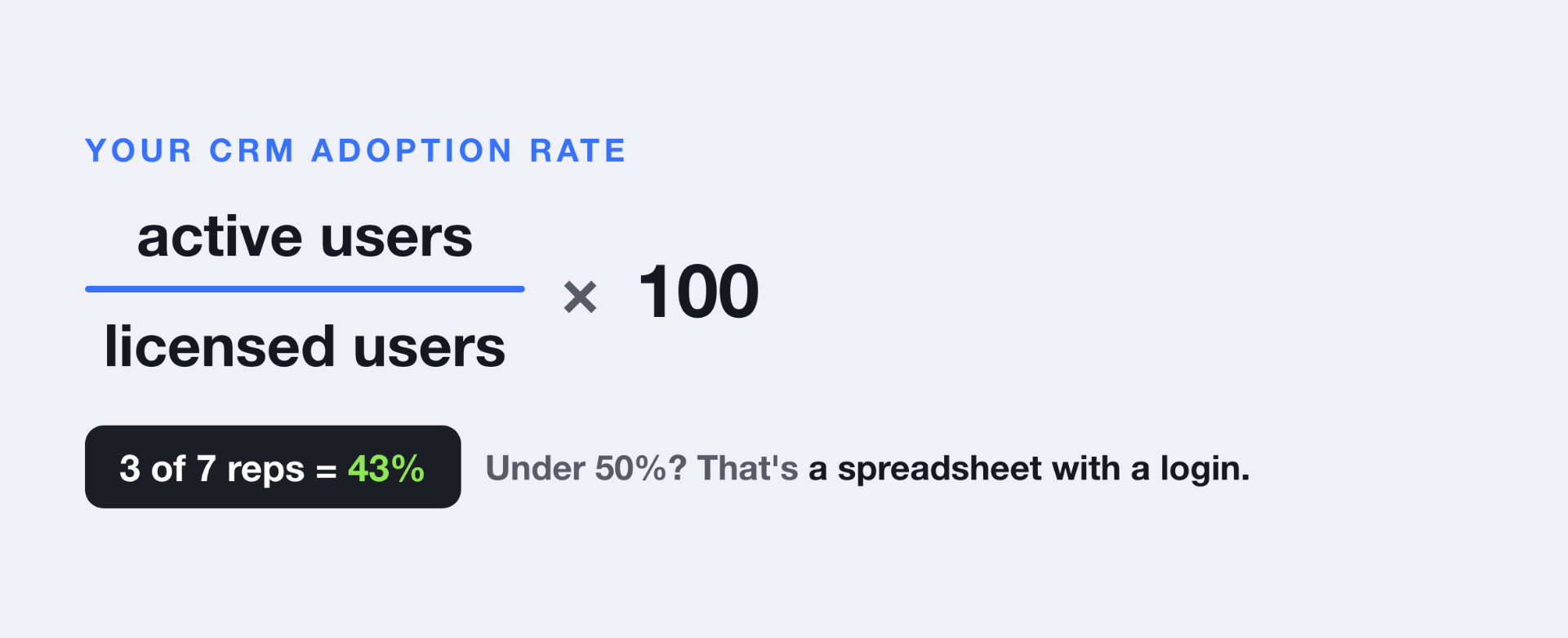
“Active” should mean logged in and doing real work weekly, not opened once. If 3 of 7 licensed reps use it weekly, that’s a 43% adoption rate, and a CRM used by fewer than half your team is a spreadsheet with a login. Even in a healthy study, fewer than 40% of companies had more than 90% of their users fully adopting the CRM (CSO Insights). Most teams sit well below that.
Why reps don’t use the CRM: it’s a tax, not a tool
Salespeople spend only about one-third of their time actually selling. The rest goes to admin, internal meetings, and data entry.
So if your CRM adds to that pile instead of cutting it, reps route around it every time. Adoption is a design problem. Make the CRM the fastest way to do the job, or people quietly go back to whatever’s faster for them.
Why CRM adoption fails: the real barriers
It’s rarely one thing. The usual suspects:
- It’s slower, not faster. Manual data entry that the tool was supposed to remove.
- It’s built for the admin, not the rep. Everyone opens the same firehose instead of their own work.
- No integration. Email, calls, and calendar live somewhere else, so the CRM is always out of date.
- Dirty data. Once reps stop trusting what’s in there, they stop looking, and it spirals.
- One-and-done training. A single go-live session with no follow-through.
- No owner. Nobody’s job is to keep adoption alive after launch.
The 90-day danger zone
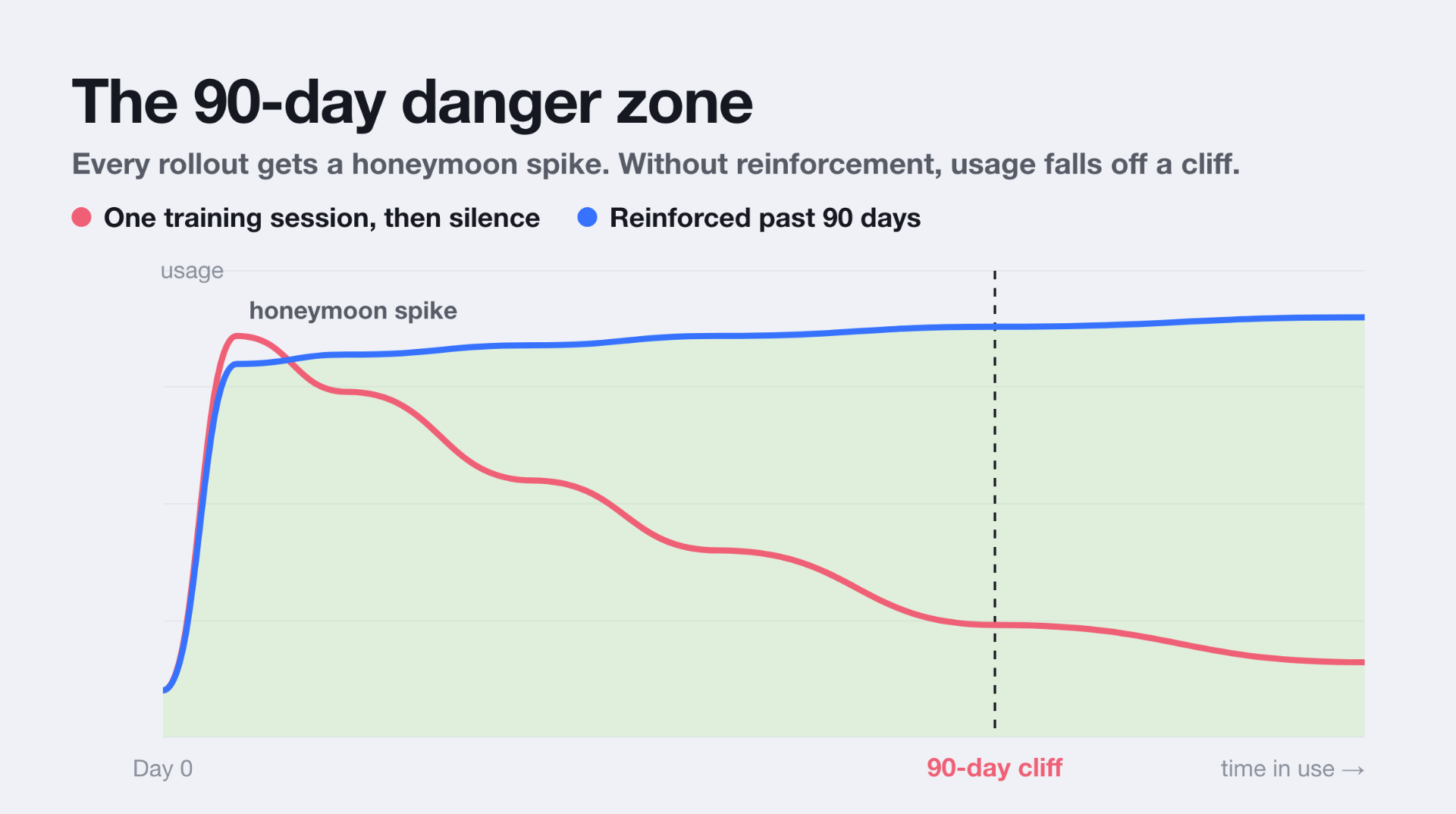
Most rollouts get a honeymoon spike. Everyone logs in the first week because it’s new. Then usage falls off, usually right around the 90-day mark, once the novelty’s gone and reinforcement stopped.
The reason is boring and human. Without reinforcement, people forget about two-thirds of what they learned within a day (the Ebbinghaus forgetting curve). One training session and a Slack channel is not a rollout. It’s a launch with no follow-through, and the CRM slides back into shelfware.
How to increase CRM adoption: 6 things that work
- Design around the person, not the admin. Every rep opens the CRM to their own work, not a wall of everything. Build the views and lists for their day.
- Kill the busywork. Automate the data entry the CRM was supposed to save. When email, calls, and touchpoints log themselves, reps stop resenting it.
- Answer “what’s in it for me.” Nobody adopts a CRM to make your reporting nicer. Show each person how it saves them time this week.
- Name an owner. Adoption needs someone accountable for it, plus a champion on the floor who models the behavior.
- Reinforce past 90 days. Check usage weekly, retrain on real data, fix what’s clunky. Adoption is a habit you build, not a switch you flip.
- Measure the right thing. Track adoption, not seats sold.
CRM adoption metrics to track
Group them into three buckets:
Weekly active users, logins, records updated per rep.
Percentage of records with complete required fields, duplicate rate, stale-record count.
Deals with full activity history, forecast accuracy, time saved per rep.
If usage climbs but data quality doesn’t, people are logging in without doing the work. Watch both.
Why this matters more in the AI era
Everyone’s bolting AI onto their CRM, and it only works on clean, current data. That data comes from adoption. In one Validity study, 44% of organizations said they lose more than 10% of annual revenue to low-quality CRM data (2022). Low adoption is garbage-in for every layer you try to build on top of it. Adoption is the foundation everything else depends on.
How we handle it
We don’t build a CRM and walk. Our packages run 90 days on purpose, because that’s the window where adoption is won or lost. We sit with each person, design the CRM around how they actually work, automate the busywork, and stay on to make sure it sticks.
When Tetrix Transport says we “didn’t leave after finishing” and “make sure my team uses it,” that line is the whole job. The build is the easy part. Getting a team to use it every day is the part most CRM projects skip, and it’s exactly the part that decides whether you ever see the return. If you’re standing up a new system, our Attio setup playbook covers the build side.
FAQ
Why do CRM implementations fail?
Almost always low adoption, not missing features. The tool works. The rollout didn’t make people actually use it.
Why don’t sales reps use the CRM?
Because it costs them time. Reps already spend most of their day not selling, so if the CRM adds admin instead of removing it, they avoid it.
How do I get my team to use the CRM?
Design it around their daily work, automate the data entry, sell the personal time savings, name an owner, and reinforce usage well past the first 90 days.
What is a good CRM adoption rate?
Aim for 80%+ of licensed users logging in and doing real work weekly. Even the best studies show most companies fall short of that.
How do you calculate CRM adoption rate?
Active users divided by total licensed users, times 100. Define “active” as weekly real usage, not a single login.
How do you measure CRM adoption?
Track usage (weekly active users, records updated), data quality (complete records, duplicates), and outcomes (activity coverage, time saved), not licenses purchased.